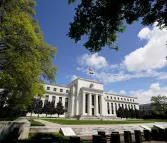


Wall Street's main indexes lost more than 1% each on Monday after U.S. President Donald Trump's attacks against Federal Reserve Chair Jerome Powell fueled concerns about the central bank's autonomy and rattled investors grappling with an intensifying trade war.
White House economic adviser Kevin Hassett said on Friday that Trump and his team would study whether firing the Fed chair was an option, a day after Trump's comments that Powell's "termination cannot come fast enough".
The continued attacks on Powell increased worries about the Fed's independence in setting monetary policy path in the world's largest economy, hitting investor confidence in U.S. assets already diminished by Trump's sweeping trade tariffs.
"The question is whether Powell could get fired. Apparently, Trump doesn't have the power to do that," said Ipek Ozkardeskaya, senior market analyst at Swissquote Bank.
"Powell looks like the only one who could counter — and win — against Trump, but the markets could well continue to be the collateral damage."
At 09:34 a.m. ET, the Dow Jones Industrial Average (.DJI) fell 449.67 points, or 1.15%, to 38,692.56, the S&P 500 (.SPX) lost 63.52 points, or 1.20%, to 5,219.18, and the Nasdaq Composite (.IXIC) dropped 226.68 points, or 1.39%, to 16,059.77.
Energy stocks (.SPNY) were the worst hit, falling 2.3%, while declines in megacap and growth stocks weighed on the information technology (.SPLRCT) and consumer discretionary (.SPLRCD) sectors.
Tesla (TSLA.O) fell 5.2% after a Reuters report said the launch of the EV-maker's cheaper Model Y car was delayed.
Nvidia (NVDA.O) was last down 3.9% after Reuters reported that Huawei Technologies planned to begin mass shipments of an advanced AI chip to customers in China as early as next month.
The small-cap Russell 2000 (.RUT) lost 1.2%.
Tariff worries continued to haunt investors after China's warning against striking deals with the U.S. at Beijing's expense. Fed policymakers also flagged a cloudy interest-rate outlook owing to tariff uncertainty.
Traders are now pricing in about 90 basis points of easing from the Fed this year, according to data compiled by LSEG.
The uncertainty over trade and monetary policy has hit stocks hard this year, with the S&P 500 (.SPX) down more than 15% from its February record high.
Company results will be keenly watched this week for clues on how corporations are navigating the uncertainty, as Tesla (TSLA.O) and Alphabet (GOOGL.O) kick off earnings for the "Magnificent Seven" megacap stocks.
Netflix (NFLX.O) shares rose 2.6% following an upbeat revenue outlook from the streaming giant despite possible economic turbulence.
Capital One Financial (COF.N) gained 2.2% after U.S. banking regulators said on Friday that they had approved its $35.3 billion purchase of Discover Financial Services (DFS.N), which advanced 4.3%.
Gold miners rose tracking prices of the safe-haven precious metal , with Newmont (NEM.N) adding 2.4%.
Declining issues outnumbered advancers by a 4.28-to-1 ratio on the NYSE, and by a 2.65-to-1 ratio on the Nasdaq.
The S&P 500 posted one new 52-week high and no new lows, while the Nasdaq Composite recorded 10 new highs and 47 new lows.