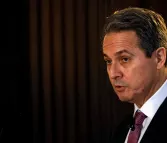
Kevin Warsh has been a sharp critic of the Federal Reserve for the last 15 years, ever since leaving his job there as a governor in 2011. His own words serve as a baseline for what to look for as he settles into his new role as Fed chair.
INFLATION IS A 'CHOICE'
"Congress tasked the Fed with the mission to ensure price stability, without excuse or equivocation, argument or anguish," Warsh said in his written testimony for his confirmation hearing last month. "Inflation is a choice, and the Fed must take responsibility for it."
His spoken version to lawmakers was even more direct about the Fed's role: "Inflation is the Fed's choice."
His words recall economist Milton Friedman's famous assertion that "inflation is always and everywhere a monetary phenomenon" and are central to Warsh's view that the post-pandemic surge in inflation was the avoidable result of a Fed error.
With inflation again on the rise amid higher oil prices and the lingering effects of tariff-driven price pressures, his view may be tested. Raising rates to try to contain inflation could put him on a collision course with President Donald Trump, who picked Warsh with the expectation he would cut interest rates.
FED'S BALANCE SHEET AND GOVERNMENT SPENDING
While many economists say the global post-pandemic inflation arose from a collision between broken supply chains and the sudden release of pent-up consumer demand, Warsh has dismissed that idea.
"I think inflation comes about when the government prints too much - by which I mean the central bank and broadly speaking the government spends too much," he told lawmakers last month.
Warsh argues that the Fed has enabled government spending by expanding its balance sheet during the financial crisis and allowing it to stay large long after the crisis was over. That's why Warsh wants to trim the Fed's balance sheet - now about $7 trillion and on path for a gradual increase - as part of his "regime-change" goal at the central bank.
What's less clear is whether he will also push for reduced government spending. Fed chairs typically stay away from making specific fiscal recommendations, though they generally and consistently warn that U.S. government borrowing is on an unsustainable path.
COMMUNICATION AND GUIDANCE
Warsh has come out strongly against the central bank's practice of telling financial markets its policy intentions as a way of increasing the impact of its actions. "Unlike many of my colleagues past and present I don't believe in forward guidance," he told lawmakers last month. "I don't believe that I should be previewing for you what a future decision might be."
To be sure, most central bankers have described forward guidance not so much as "previewing" a future decision as mapping out their likely response should the economy behave in a certain way.
Warsh arrives at the Fed amid deep disagreement over one current form of forward guidance - phrasing in the Fed's post-meeting statement that suggests the central bank's next move, when it comes, will be an interest-rate reduction. Many policymakers in April felt the statement should be rewritten to show that the Fed could raise rates as easily as cut them.
Warsh may also try to end other forms of Fed forward guidance, including its quarterly economic projections that include Fed policymaker forecasts for the economy and what they feel would be the appropriate path of policy in response.
DATA DEPENDENCE - OR NOT
Warsh thinks the Fed pays too much attention to the details of economic data that in many cases is released well after the fact and with, he feels, more precision than should be relied on.
"In economics what we need to do is focus to the left of the decimal point, not to the right of the decimal point," Warsh told lawmakers last month. If implemented literally, this view could have profound ramifications, as it could mean he feels the Fed should treat April's 3.8% consumer inflation reading as no different from the March reading of 3.3%, or that reaching 2.9% inflation is as good as bringing it all the way down to the Fed's 2% goal.
NO PROMISES AND NIMBLE RESPONSES
Last month Warsh told lawmakers he had made Trump no promises on interest rates. "The president never asked me to predetermine, commit, fix, decide on any interest-rate decision in any of our discussions, nor would I ever agree to do so." At the same time, he said, "if mistakes are made, central bankers - economic policy makers - need to correct them fast."
Those words will come under scrutiny in coming months, as the Fed debates what to do not only with its forward guidance but also with the policy rate.
WHAT HE DIDN'T SAY
Warsh's silence on a range of other topics raises important questions.
He never said - nor was he asked directly - if he feels the Fed's policy rate is too high or is otherwise miscalibrated.
He did not reaffirm a commitment to the Fed's 2% inflation goal - though whether the omission means he favors a different goal or no specific numeric target at all is far from clear. Nor did he lean into the importance of inflation expectations as a determinant of actual inflation - a central pillar of modern central banking and a frequent topic for Powell.
To the other side of the Fed's dual mandate - maximum employment - he offered almost no view at all.
And he declined to weigh in on Trump's attempt to oust Fed Governor Lisa Cook, now before the Supreme Court in what Powell has said is the most important legal case in the Fed's history.