U.S. President Donald Trump is a renowned champion of fossil fuels, but the lasting legacy of the war against Iran is likely to be an acceleration of the energy transition, especially in Asia.
The world's most populous and fastest-growing region is being hit hard by the fallout from the U.S. and Israeli aerial campaign against Iran, which has seen rapid increases in retail fuel prices since the conflict began on February 28.
For example, the price of a litre of diesel in Australia has hit record highs around A$3 ($2.09), having risen around 36% since the war started, while in Japan gasoline has jumped by 18%.
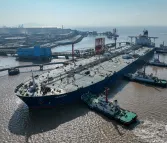
Countries that control prices are starting to struggle with fuel availability as the conflict has effectively shut the Strait of Hormuz, the narrow waterway that normally transports around 20 million barrels per day (bpd) of crude and refined products from the Persian Gulf to mainly Asian countries.
While global benchmark Brent crude futures have gained about 42% since the start of the conflict to trade around $103.78 a barrel in Asia on Tuesday, the increase in physical prices for refined products such as diesel and gasoline has been far higher.
Singapore gasoil, the building block for diesel, has jumped by 104% since February 27 to end at $186.43 a barrel on Monday, while gasoline has risen 91% to a record high of $151.60.
These sharp increases make it likely that further pain will be experienced by consumers across Asia in coming weeks and months, with the added risk of supply shortages as refineries in the region struggle to source crude.
The huge price spikes and the fear of shortages are likely to boost the appeal of electric vehicles (EVs) and plug-in hybrid-electric vehicles (PHEVs), as well as electric motorbikes in Asia.
Already EVs and PHEVs are making inroads in many countries, driven by the increasing cost-competitiveness of Chinese cars and some government incentives that boost affordability.
China is the leader in the adoption of EVs, which isn't surprising given the massive investment in battery technology the country has made in recent years.
Sales of EVs and PHEVs were around 12 million units in China last year, taking a more than 50% share of new vehicle sales for the first time.
While this may rise toward 60% this year, it's outside of China that the biggest opportunity for growth lies.
AUSTRALIA GROWTH
Australia's sales of EVs and PHEVs hit a record high in 2025 and accounted for about 12.7% of total light vehicle purchases.
PHEVs saw faster growth as consumers still worry about battery range and availability of electric charging facilities.
Cheaper EVs and PHEVs, as well as government tax incentives for leases, are helping boost sales in Australia, but the bigger question is how deeply will the current fuel crisis scar consumers, and how many will try to insulate themselves from future shocks by turning to battery power.
Australia already has more than one-third of households with rooftop solar, which is a further incentive to switch to EVs and PHEVs as they can use their own electricity to charge the vehicles, further lowering costs.
Japan is another market that could see far faster growth in EVs and PHEVs, especially since their major car manufacturers are starting to catch up by offering more models, especially PHEVs.
Strong growth in EVs and PHEVs has also been seen in several Southeast Asian countries, but it's worth noting that electric motorbikes are starting to make more of an impact.
In India, almost 1.3 million electric two-wheelers were sold in 2025, an increase of more than 10% on the prior year and expanding the market share to more than 6% of total sales.
While that is a strong growth rate, it shows the scope for even faster growth in coming years, especially if retail fuel prices remain elevated.
Overall, the impact from the Middle East conflict may extend long after the eventual resolution and reopening of the Strait of Hormuz.
Asian countries have just received a massive incentive to switch to EVs and PHEVs, as well as to renewable energies like wind and solar.
While not a direct comparison, the experience of Europe after the dieselgate scandal of 2015 - in which Volkswagen was caught manipulating emissions tests - is instructive.
Diesel passenger car sales dived from 52% in 2015 to just 8% in 2025. The main immediate beneficiary was gasoline-powered cars, but more recently, EVs and PHEVs have overtaken diesel vehicles.
The lesson is that once a trend takes hold it becomes hard to reverse it. The risk for exporters of crude oil and refined products is that the war will change the mindset of consumers and governments, and reorientate demand and policies to EVs, PHEVs and renewable-energy generation.
Enjoying this column? Check out Reuters Open Interest (ROI), your essential new source for global financial commentary. ROI delivers thought-provoking, data-driven analysis of everything from swap rates to soybeans. Markets are moving faster than ever. ROI can help you keep up. Follow ROI on LinkedIn and X.
The views expressed here are those of the author, a columnist for Reuters.