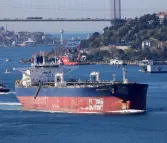

Dozens of oil tankers used by Russia have stopped sailing under the Liberian and Marshall Islands flags in recent weeks after the United States ramped up sanctions enforcement on ships linked to those registries, according to shipping data and interviews with industry and government officials.
The shift reflects the close relationship between the U.S. and the flag administration companies of Liberia and the Marshall Islands, which are headquartered not in their home countries, but in Virginia, just miles from Washington D.C. and within the jurisdiction of U.S. sanctions enforcement.
The heavy past use of those flags also represents a potentially lasting vulnerability for Russia’s oil fleet, whose tankers will remain liable for sanctions violations even after they have switched to a new flag outside of U.S. reach, according to energy and sanctions specialists.
"They've created an enduring liability and enduring risk," said Craig Kennedy, a center associate at Harvard University's Davis Center for Russian and Eurasian Studies.
Commercial ships must be registered, or flagged, with a particular country to ensure they are complying with internationally recognized safety and environmental rules.
Reuters analyzed LSEG and Lloyd's List Intelligence shipping data, and interviewed government officials, flag registry representatives and shipping analysts to provide previously unpublished details on the role of flag registries in the recent wave of U.S. sanctions announcements targeting Russia's oil fleet, and the vulnerabilities they pose to Russian oil shipping.
The G7, the EU and Australia imposed a $60 a barrel price cap on Russian oil exports in December 2022 as part of wider economic sanctions aimed at cutting Moscow’s revenues without disrupting global energy supplies, following Russia’s invasion of Ukraine.
The cap bans the use of Western maritime services when tankers carry Russian oil priced at or above the cap. A U.S. official, who requested anonymity when speaking about the sanctions, confirmed that the Liberian and Marshall Islands flag registries qualify as Western services.
Since October, the U.S. Treasury Department has imposed sanctions on some 41 oil tankers for Russian price cap violations, 24 of which were flying the Liberian flag and one of which was using the Marshall Islands flag.
Almost all of the other tankers were flagged in Gabon, including 12 of the 14 targeted by the Treasury Department in its most recent bundle of sanctions on Feb. 23. Of those Gabon-flagged tankers, in which Russia's top shipping company Sovcomflot (SCF) has an interest, at least three had recently flown the Liberian flag, according to Reuters' analysis of shipping data.
Those tankers were among a slew of ships in the SCF fleet moving to Gabon, according to the data: as of early February, SCF had 42 tankers in its 147 tanker fleet that had recently shifted to the Gabon flag, mainly from Liberia and Panama.
SCF declined to comment and Russia's transport ministry did not respond to a request for comment.
The Liberian flag registry told Reuters that all the Liberian-flagged vessels which were sanctioned were in the process of having their Liberian flags removed. "We are all living in a different world right now and the registries need to adapt to what the global situation is at this point," the Liberian registry said.
The registry declined to comment on its previous business with SCF.
A U.S. official told Reuters that Liberia had been actively engaged with the Treasury Department, and that sanctioned tankers have about a three-month wind down period to switch to another flag.
Marshall Islands registry officials are also in contact with U.S. agencies on the issue, a Marshall Islands registry spokesperson said.
Gabon Transport Minister Loic Moudouma confirmed to Reuters that many tankers had left the Liberia registry for Gabon recently, and said Gabon would de-list them if they are found to be engaged in illegal activity.
“We are not a flag registry for the world’s rogue navigators or transporters,” he said.
“If any ally, any partner in the world, realizes that there is a Gabonese ship flying the Gabonese flag and carrying out illegal activities, all they have to do is send us the file in full and we will take steps to remove the flag from this ship ourselves. Whether Russian or any other nationality."
Panama officials did not respond to a request for comment.
INVITING TROUBLE
The sanctions imposed so far have sent a chill through the industry involved in Russian trade.
Many of the still to be de-listed Liberian-flagged vessels, for example, are stuck, sitting at anchor outside of ports across the world including in the Black Sea, according to shipping data, marking a costly liability for their owners and those financially linked to their cargoes.
U.S. Treasury Department sanctions can have a "contagion" effect on tankers by dissuading market players from dealing with them, according to Harvard's Kennedy.
"In the dollar denominated world of oil trading, why put a deal worth tens of millions of dollars at risk by using a blocked tanker? You're just inviting trouble for everyone involved," he said.
Switching to the Gabon flag could also invite additional risk at ports for tankers carrying Russian oil.
A U.S. official said tankers that carried Russian oil above $60 that switch to the Gabon flag could also have a more difficult time with port authorities concerned about the safety of ageing tankers.
The United States, European Union and UK issued a letter late last year pressuring Liberia, the Marshall Islands and Panama to increase oversight of ships carrying their flags to ensure they do not transport Russian oil sold above the price cap, a source told Reuters at the time.
While the U.S. has been the primary enforcer of the price cap, other countries in the mechanism are working with Washington to tighten the screws.
"We're making it harder for Russia to use its shadow fleet, which in turn would force more volume back into the G7 fleet, where service providers are compliant with the cap," Olga Dimitrescu, an official at the UK Treasury’s sanctions enforcement arm OFSI told a Feb. 1 podcast with ship insurer NorthStandard.
U.S. officials say shipping practices related to the export of Russian oil above the West's price cap are in their crosshairs. "We are very concerned about evasion, I think that's clear from the actions we've taken," Claire McCleskey, an official with the U.S. Treasury's sanctions enforcement arm OFAC, told a New York shipping conference last month.
"You can anticipate our continuing to take action."